
If you’ve been asked to provide a “beglaubigte Übersetzung” for the Ausländerbehörde, a university, or a notary in Germany, this guide explains exactly what you need, what it costs, and how to get it, without the confusion.
Every year, hundreds of thousands of people in Germany face the same situation: they have an official document (a birth certificate, a university diploma, a court order) written in a language that German authorities won’t accept without translation. And not just any translation. A sworn translation.
But what exactly does “sworn” mean in the German context? Is it different from “certified”? Do you really need to find a translator physically near you? And how much should it cost? This guide answers all of it.
What is a sworn translation in Germany?
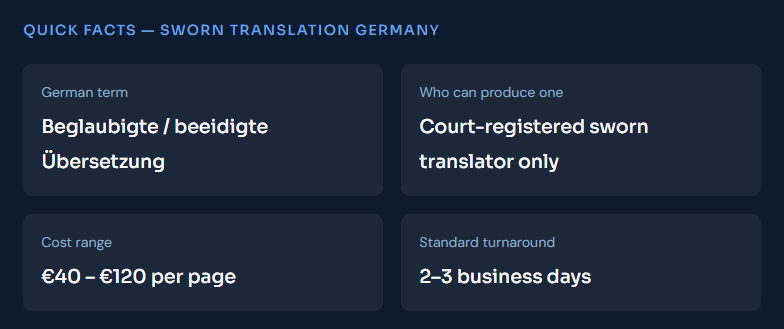
A sworn translation in Germany (officially called a beglaubigte Übersetzung or beeidigte Übersetzung) is a translation of an official document that has been certified by a translator who holds a specific legal status: they have been publicly appointed and sworn in by a German district court (Landgericht).
What makes a sworn translation different from a regular translation is not just accuracy. It is the legal certification attached to it. After completing the translation, the sworn translator appends a certification statement, their personal court stamp, their handwritten signature, and the date. This combination is what gives the document its legal validity in Germany.
The certification statement typically reads: “As duly appointed and sworn translator for [language] by [court], I hereby certify that this is a true and complete translation of the document presented to me.” This sworn declaration is what German authorities look for.

The German legal basis
Sworn translators in Germany operate under § 189 of the German Code of Civil Procedure (Zivilprozessordnung, or ZPO). Under § 142 Sec. 3 ZPO, certified translations submitted to German courts must bear the translator’s official stamp. Sworn translators hold a duty of confidentiality under the same code.
Each German federal state (Bundesland) maintains its own official registry of sworn translators. You can look up a translator in your state’s registry, though in practice most people work through a translation agency that manages this for them.
Sworn vs. certified translation. What’s the difference?
This is one of the most common points of confusion, and the answer is simpler than you might expect.
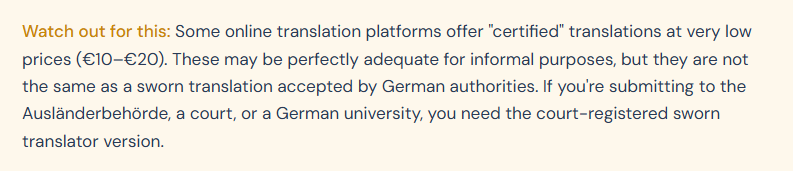
In Germany, the terms sworn translation, and certified translation, all refer to exactly the same thing. They are legally interchangeable. There is no distinct category of “certified” vs. “sworn” in German law, what matters is the translator’s court-registered status and the certification attached to the translated document.
The confusion often arises because in countries like the United States or United Kingdom, “certified translation” means something different, typically a certificate signed by the translator or agency attesting to accuracy, without any court registration requirement. A US-style certified translation is not accepted by German authorities for official purposes.
Which documents require a sworn translation in Germany?
As a general rule: any non-German document that you submit to a German authority, court, notary, or university as part of an official application will require a sworn translation. Here is a breakdown by category:
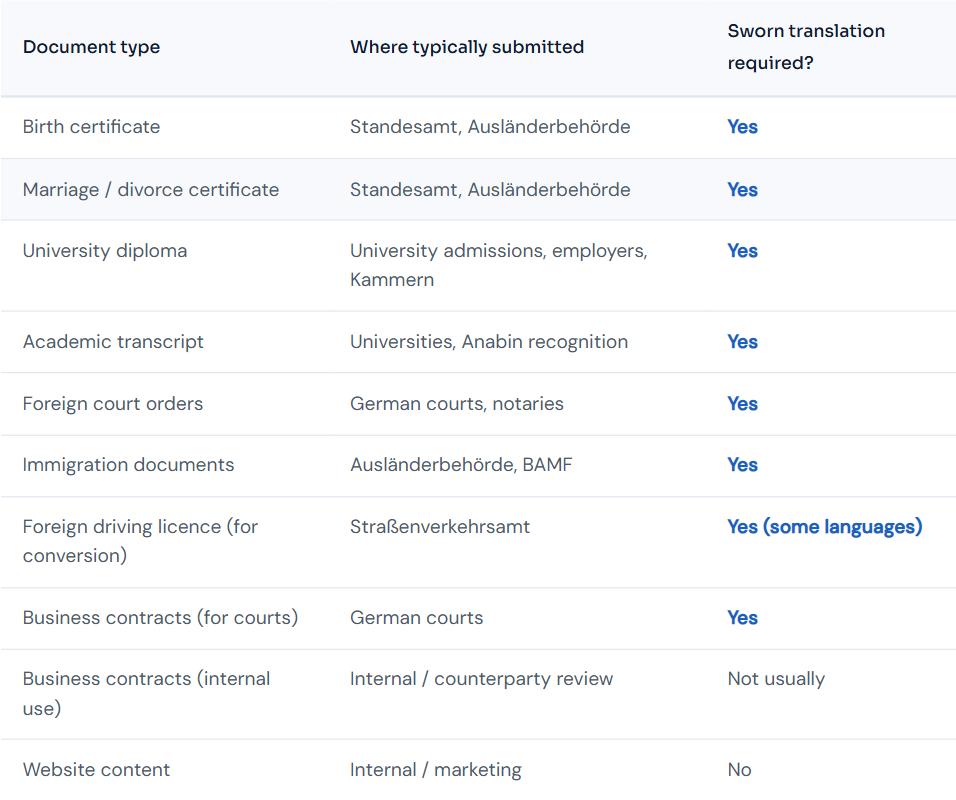
If you are unsure whether your specific document requires a sworn translation, the safest approach is to check directly with the German authority you are submitting to. Many German agencies have published checklists online (the Ausländerbehörde in most cities, for example, lists required documents on their website).
How to find a sworn translator near you in Germany
Here is something that surprises most people: you do not need to find a sworn translator physically near you.
A sworn translation produced by any court-registered translator in Germany is legally valid nationwide, regardless of which Bundesland the translator is registered in, and regardless of where you are in Germany. A sworn translator registered in Hamburg can produce a legally valid certified translation for use at the Ausländerbehörde in Munich or the Standesamt in Frankfurt. Location makes no difference to validity.
This means the search query “sworn translator near me” (while completely understandable) is actually unnecessary. The entire process can be done online. You email your document, the translator certifies it, and the original is posted to you by mail.
Where to find official sworn translators in Germany
If you want to find a translator directly, each German state maintains an official database:
- Bavaria (Bayern): Register of translators and interpreters via the Bavarian Ministry of Justice
- Berlin / Brandenburg: Register maintained by the Kammergericht Berlin
- North Rhine-Westphalia: Justizministerium NRW
- Other states: Contact the relevant Landgericht or the BDÜ (Bundesverband der Dolmetscher und Übersetzer e.V.)
Alternatively, using a certified translation agency (such as Linguidoor) means the agency handles translator assignments for you, including matching your document to a translator with the right subject-area expertise and language combination.
How much does a sworn translation cost in Germany?
Sworn translation pricing in Germany is typically structured per page (usually defined as up to 250 words). There is no single fixed national price, rates vary by language pair, subject matter, and turnaround speed. Here is what you can expect to pay:
| Service | Price range | Turnaround |
| Standard sworn translation | €40 – €80 per page | 2–3 business days |
| Express sworn translation | €70 – €120 per page | 24 hours (excl. weekends) |
| Rare language pairs | €80 – €150+ per page | 3–5 business days |
| Long documents (10+ pages) | Volume discounts apply | Agreed per project |
At Linguidoor, standard sworn translations start from €49 per page and express translations from €69 per page, with transparent fixed pricing before you confirm your order.

What does the sworn translation process look like?
The process for obtaining a certified sworn translation in Germany is straightforward, and, as noted above, can be done entirely online:
- Email your document. Send a clear scan, photograph, or PDF. The translator needs to be able to read all text, including stamps and signatures, as these must be reflected in the translation.
- Receive a quote. A reputable agency will provide a fixed, no-obligation price quote and a confirmed delivery date.
- Translation and certification. Your court-registered sworn translator completes the translation, attaches the certification statement, applies their court stamp, and signs the document.
- Delivery. The certified original is posted to you. Many agencies also provide a digital PDF copy (though for submission to German authorities, you typically need the signed paper original).
One practical note: German authorities usually want the original certified document, not a photocopy. Keep this in mind if you need to submit to multiple places.
Do you also need an apostille?
An apostille is a separate question from the sworn translation. It is an additional authentication step required in certain international situations under the Hague Apostille Convention of 1961.
In Germany, you may need an apostille in these circumstances:
- You are submitting a German document abroad (the apostille authenticates the German issuing authority’s seal).
- You have a foreign official document that was issued in a Hague Convention country and need to submit it in Germany, in some cases the receiving German authority may require an apostilled original before accepting a sworn translation.
Whether an apostille is required depends on the specific authority you are submitting to and the country of origin of the document. If you are unsure, we advise you to contact the receiving authority directly, or ask us and we will guide you.
Frequently asked questions
- Can I use a foreign sworn translator for documents in Germany?
Generally not. German authorities typically require a translator registered with a German district court. A translator sworn in another country (even an EU country) may not be accepted by German Ausländerbehörden, courts, or universities. To be safe, always use a German court-registered translator for documents intended for German official purposes.
- Does a sworn translation need to be on special paper or have a specific format?
No special paper is required by law. What matters is the translator’s sworn certification statement, court stamp, signature, and date. German regulations also require that the layout of the certified translation broadly resembles the layout of the source document, and that the translator accounts for all stamps, signatures, and markings in the original.
- What if my document is very long, like an entire academic file?
Long documents can absolutely be certified. Volume pricing typically applies for documents over 10 pages, which reduces the per-page cost. You will receive a confirmed total price and timeline before your order is processed. For academic files or bundles of related documents, it helps to share everything at once so the agency can quote the full scope.
- How do I know the German authority will accept my sworn translation?
A sworn translation produced by a translator registered with any German district court is legally valid and must be accepted by German authorities. If you are using a German-registered translator through a reputable agency, the translation will be compliant. If in doubt, you can verify your translator’s registration in your state’s official translator registry.
- Can I get a sworn translation on the same day?
24-hour express sworn translations are available at Linguidoor, including on weekends and public holidays, for most language pairs. For very rare language combinations or very long documents, turnaround may be slightly longer. Contact us with your document and deadline and we will confirm availability.