
Budgeting for website localization is genuinely difficult, not because vendors are opaque (though some are), but because the range of legitimate costs is enormous. A freelance translator and an enterprise localization vendor both do “website localization,” and their prices can differ by a factor of 20x or more.
This guide is part of our Website Localization: The Complete Guide. New to the topic? Start with What Is Website Localization? before diving into costs.
This guide cuts through the noise. You’ll find real-world cost ranges, a clear explanation of what drives prices up or down, a breakdown by project type, and honest advice on how to avoid overpaying without cutting corners that hurt your results.
The Short Answer: What Does Website Localization Cost?
There is no single answer, but here are honest ranges:
| Project Type | Estimated Total Cost |
| Small website (10–20 pages), 1 language | $1,500 – $6,000 |
| Medium website (30–60 pages), 1 language | $5,000 – $20,000 |
| Large website (100+ pages), 1 language | $15,000 – $50,000+ |
| Each additional language (same content) | 70–90% of first-language cost |
| E-commerce store (200+ product pages) | $10,000 – $80,000+ |
| SaaS platform (UI strings + marketing site + docs) | $20,000 – $150,000+ |
| Ongoing maintenance (per language, per month)→ Going deeper on SaaS localization: SaaS Website Localization: A Guide for Software Companies Going Global | Entering Germany specifically: Website Localization for Germany: What Businesses Get Wrong | $500 – $5,000/month |
These are all-in estimates covering translation, cultural adaptation, technical implementation, and QA. Variables (which we’ll explain in detail) can push costs well above or below these ranges.
How Website Localization Is Priced
Understanding the pricing model helps you evaluate quotes intelligently and avoid surprises.
Per-Word Translation Rates
The core translation cost is almost always priced per word, specifically, per word of the source content (the language you’re translating from).
Human translation rates:
| Language Pair | Rate Per Word (Approx.) |
| English → European Spanish | $0.10 – $0.18 |
| English → French | $0.12 – $0.20 |
| English → German | $0.12 – $0.22 |
| English → Japanese | $0.18 – $0.35 |
| English → Chinese (Simplified) | $0.12 – $0.25 |
| English → Arabic | $0.14 – $0.28 |
| English → Korean | $0.16 – $0.30 |
| English → Portuguese (Brazilian) | $0.10 – $0.18 |
| English → Dutch | $0.12 – $0.20 |
| English → Russian | $0.10 – $0.18 |
Rates vary based on language pair, content type, and vendor. Rare language combinations (English → Swahili, English → Malay) typically cost more. Technical or specialized content (legal, medical, financial) commands a premium of 20–50% over standard rates.
Machine Translation + Human Post-Editing (MTPE):
MTPE is the current industry standard for balancing quality and cost. Machine translation handles the first pass; a human linguist reviews and corrects the output.
| MTPE Level | Description | Rate Per Word |
| Light post-editing | Correct errors only, don’t improve style | $0.04 – $0.07 |
| Full post-editing | Correct errors + improve fluency and style | $0.06 – $0.12 |
MTPE quality is now genuinely good for most content types. For brand-critical copy, marketing headlines, and legally sensitive content, full human translation (or at minimum full post-editing) is still recommended.
→ Wondering when to use machine translation at all? See: Automated Website Translation: When It Works and When It Doesn’t
Machine translation only:
Rates are typically $0.01–$0.03 per word at volume. Not recommended for customer-facing content. Suitable for internal documents, low-priority pages, or rapid first-draft review.
What You’re Actually Paying For: The Full Cost Breakdown
The translation rate is just one line item. A complete localization budget includes:
1. Translation and Linguistic Services
This is the largest cost for most projects.
● Translation of page copy — body text, headings, CTAs, navigation
● UI string translation — error messages, button labels, tooltips, dropdown options
● Metadata translation — meta titles, meta descriptions, image alt text
● Legal content translation — privacy policy, terms of service, cookie policy
● Blog and resource content — if you’re localizing your content library
How to estimate your word count: Export all text from your CMS. For reference, a typical 1,000-word page in English will expand to approximately 1,100–1,400 words when translated into German or French (text expansion of 10–40%). Budget for the expanded word count when doing reverse estimates.
2. Cultural Adaptation and Transcreation
Not all content can be directly translated. Marketing copy (taglines, campaign headlines, slogans, product descriptions with personality) often needs transcreation: rewriting for cultural and emotional resonance rather than literal accuracy.
→ Not sure where translation ends and localization begins? See: Website Localization vs. Translation: A Complete Comparison
Transcreation is billed hourly or per project, not per word, because it’s creative work, not translation.
| Service | Typical Rate |
| Transcreation (marketing copy) | $75 – $200 per hour |
| Cultural consultation per market | $500 – $3,000 |
| Imagery review and cultural audit | $300 – $1,500 |
3. Technical Implementation
Getting translated content into your website is a technical task. Costs depend on your tech stack and how your content is structured.
| Implementation Task | Typical Cost |
| i18n audit of existing website | $500 – $3,000 |
| Developer setup of i18n framework | $1,000 – $8,000 |
| TMS integration with CMS or Git | $500 – $3,000 |
| Hreflang implementation and testing | $300 – $1,500 |
| RTL layout implementation (Arabic/Hebrew)→ Building for Arabic or Hebrew markets? See our full guide: Arabic Website Localization: RTL Design, Cultural Norms, and Technical Challenges | $2,000 – $8,000 |
| URL structure setup (/de/, subdomains, ccTLD) | $300 – $1,500 |
| Payment method localization (checkout) | $500 – $5,000 |
If your website wasn’t built with internationalization in mind, expect a higher technical bill. Retrofitting i18n onto a monolithic, hardcoded site is significantly more expensive than building or rebuilding with i18n support from the start.
→ Unsure whether your site is ready for localization? Read: Website Internationalization (i18n) vs. Localization (l10n): What Developers Need to Know
4. Localization QA
Quality assurance catches linguistic errors, broken layouts, untranslated strings, and functional issues. It’s not optional if you care about quality.
| QA Type | Typical Cost |
| Linguistic QA (proofreading by second linguist) | $0.02 – $0.05 per word |
| In-context review (reviewing live/staged site) | $500 – $2,000 |
| Functional QA (testing forms, checkout, links) | $500 – $3,000 |
| User testing with native speakers→ Want the full QA framework? See: Website Localization Testing: How to QA Your Localized Site Before Launch | $1,000 – $5,000 |
5. Tools and Software
If you’re running localization at scale, you’ll need a Translation Management System.
| Tool Category | Examples | Typical Cost |
| Translation Management System (TMS) | Lokalise, Phrase, Crowdin | $100 – $2,000/month |
| Machine Translation API | DeepL, Google Translate API | $0–$50/month (low volume) to $500+/month (high volume) |
| International SEO tools | Semrush, Sistrix | $100 – $500/month |
| Localization testing tools | Xbench, Lingoport | $50 – $500/month |
For small projects (one website, one language), you may not need a TMS subscription, your LSP (localization service provider) will often manage files on their end.
→ Comparing tools in depth? See: Best Website Localization Tools in 2025: Platforms, Plugins, and Integrations
6. Ongoing Maintenance
Localization is never truly “done.” Every new page, updated product, new blog post, and changed UI element needs to be localized.
Ongoing costs depend on your content velocity. A fast-moving SaaS company with a weekly publishing cadence will spend dramatically more on maintenance than a small business with a mostly static website.
Rough maintenance estimates per language per month:
● Low content velocity (static site, <5 updates/month): $200 – $800/month
● Medium content velocity (blog, product updates, 10–20 updates/month): $800 – $3,000/month
● High content velocity (daily updates, large content library): $3,000 – $10,000+/month
What Drives Localization Costs Up
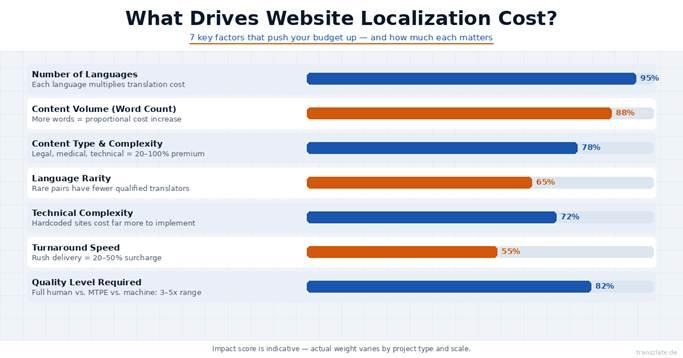
Figure 1: The 7 key factors that push website localization costs up, and their relative impact.
1. Number of Languages
Each language roughly multiplies your translation cost. Technical costs don’t multiply equally (setting up the framework once covers all languages) but translation, QA, and cultural adaptation are per-language costs.
Good news: after the first language, subsequent languages are typically 70–90% of the first-language cost for the same content (the infrastructure is already in place).
2. Content Volume
More words = higher cost, proportionally. This makes the content audit before quoting critical. Vendors who quote without a word count are guessing.
3. Content Type
Standard web copy is the cheapest to translate. Specialist content costs more:
| Content Type | Relative Cost vs. Standard Web Copy |
| Standard marketing copy | Baseline |
| Technical documentation | +20–40% |
| Legal/compliance content | +30–50% |
| Medical/pharmaceutical | +50–100% |
| Financial/regulated content | +30–60% |
| Software UI strings | +15–30% |
4. Language Rarity and Complexity
Common European languages (Spanish, French, German) are competitive markets with many qualified translators, which keeps prices moderate. Less common languages (Welsh, Catalan, Icelandic, Swahili, Thai) are specialty markets where qualified translators are fewer and prices are higher.
Languages with complex writing systems (Japanese, Arabic, Chinese) and RTL languages also carry higher costs due to additional technical and linguistic complexity.
5. Turnaround Time
Rush projects cost more. Standard turnaround for professional translation is typically 1,500–2,500 words per day per translator. If you need 50,000 words translated in a week rather than a month, expect premium pricing of 20–50% above standard rates.
6. Technical Complexity of Your Website
A static WordPress site with a few pages is cheap to implement. A complex React SPA with thousands of hardcoded UI strings, a multilingual checkout, third-party integrations, and a custom CMS will have a substantial technical implementation cost regardless of translation volume.
7. Quality Level Required
A premium service (human translation + second-linguist editing + in-context review + native-speaker user testing) costs 3–5x more than machine translation alone, and in many cases, it’s worth every cent for high-conversion, brand-critical content. The question isn’t just “what does it cost?” but “what does bad localization cost in lost conversions, reputation damage, and regulatory risk?”
What Drives Costs Down (Without Sacrificing Quality)
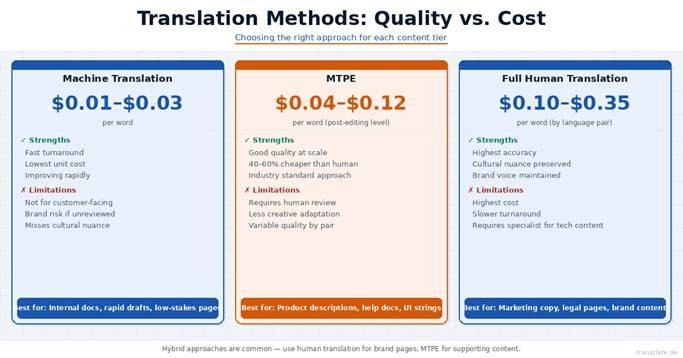
Figure 2: Machine translation vs. MTPE vs. full human translation — quality, cost, and best use cases.
1. Leveraging Translation Memory
Translation memory (TM) is a database of previously translated sentence pairs. When new content contains segments that match previously translated content, the TM reuses them, and most vendors charge less (or nothing) for TM matches.
A mature TM can reduce translation costs by 20–40% for websites that are frequently updated with overlapping content.
2. Machine Translation + Human Post-Editing
For most content types, MTPE produces excellent results at 40–60% of full human translation cost. Use it wisely, for brand-critical marketing copy or legal content, the savings aren’t worth the quality risk. For technical documentation, help center content, and product descriptions, MTPE is often the smart choice.
3. Content Cleanup Before Localization
Localization amplifies whatever is already in your source content. Vague copy, inconsistent terminology, and marketing fluff are all expensive to translate, and they don’t get better in another language. A content audit before localization that removes redundant pages, consolidates similar content, and standardizes terminology can meaningfully reduce word count and cost.
4. Prioritizing Pages by Revenue Impact
Don’t localize everything at once. Identify your highest-traffic, highest-converting pages and localize those first. Prove ROI before expanding scope. A phased approach keeps costs manageable and lets you validate the investment early.
5. Using the Right Tool for Your Scale
A solopreneur localizing one small website doesn’t need a $1,000/month TMS. A plugin like WPML ($99/year) or a lightweight TMS like Weglot ($190/year for small sites) is more appropriate. Match your tooling to your scale.
Sample Budget Scenarios
Scenario A: Small Business, One New Market
Company: UK-based consulting firm, ~15-page website Target market: France Approach: MTPE (full post-editing) + technical setup
| Item | Cost |
| Translation (6,000 words at $0.09/word MTPE) | $540 |
| Hreflang + URL structure setup | $400 |
| QA (linguistic + in-context review) | $400 |
| Cultural review | $300 |
| Total | ~$1,640 |
Scenario B: E-commerce Brand, Three Languages
Company: German-headquartered fashion brand, ~80 product pages + marketing site Target markets: France, Netherlands, Spain Approach: Human translation for marketing pages + MTPE for product descriptions
| Item | Cost |
| Translation, marketing site (~15,000 words × 3 languages at $0.15/word avg.) | $6,750 |
| Translation, product descriptions (~40,000 words × 3 languages at $0.08/word MTPE) | $9,600 |
| Technical implementation (TMS setup + i18n developer work) | $4,000 |
| QA across 3 languages | $2,500 |
| Cultural review + imagery audit→ Running an international e-commerce store? See: eCommerce Website Localization: How to Sell Internationally Without Losing Conversions | $1,500 |
| Total | ~$24,350 |
Scenario C: SaaS Platform, Full Localization Program
Company: B2B SaaS startup, entering German market Scope: Marketing site + app UI strings + help center + legal pages
| Item | Cost |
| Marketing site translation (~20,000 words, human translation) | $3,600 |
| App UI strings (~15,000 words, MTPE) | $1,350 |
| Help center articles (~50,000 words, MTPE) | $4,500 |
| Legal/compliance content (human translation + legal review) | $2,500 |
| Technical implementation (i18n framework + TMS integration) | $8,000 |
| QA + user testing | $3,000 |
| TMS subscription (Lokalise, annual) | $1,500 |
| Year 1 total | ~$24,450 |
| Ongoing maintenance (€1,500/month estimated) | $18,000/year |
Hidden Costs to Watch Out For
Minimum fees: Many LSPs have per-project minimum charges of $50–$200, which can make small, ongoing updates more expensive than expected.
File handling fees: Some vendors charge for file preparation and formatting, especially for complex formats (InDesign, XLIFF, JSON). Clarify this upfront.
Revision rounds: If you change your source content after translation has begun, expect additional charges. Scope changes mid-project are common and expensive.
Desktop publishing (DTP): If you have PDF brochures, InDesign files, or other designed assets, typesetting translated text back into them is a separate cost ($50–$200+ per page).
Glossary and style guide creation: Building a terminology glossary and brand style guide for each language is a one-time but worthwhile investment ($500–$2,000 per language). Some vendors include this; others charge separately.
→ Want to avoid the full list of expensive errors? See: 7 Website Localization Mistakes That Kill International Conversions
Is It Worth It? Calculating ROI
Localization ROI is measurable. Here’s a simple framework:
- Identify your baseline conversion rate in an unlocalized target market (from analytics data)
- Estimate potential market size (monthly visits from that market × average order value or LTV)
- Model conversion improvement — industry average is 1.3–2x improvement in conversion rate post-localization
- Compare projected revenue increase against localization cost
Example:
● 5,000 monthly visitors from France
● 0.5% current conversion rate (on an English site) = 25 conversions/month
● Average LTV: €500
● Projected post-localization conversion rate: 1.2% = 60 conversions/month
● Additional monthly revenue: 35 × €500 = €17,500
● Localization investment: €8,000 one-time + €500/month maintenance
● Payback period: less than 2 months
This is a simplified model (your numbers will vary) but the principle holds: for markets where you already have organic traction, localization ROI is typically fast.
→ For a complete ROI framework with real modelling tools: How to Measure the ROI of Website Localization
How to Get Accurate Quotes
To get meaningful quotes from vendors:
- Do a content audit first. Provide vendors with your actual word count by content type.
- Specify your language pairs. “European languages” is not a sufficient brief.
- Describe your tech stack. CMS, framework, file formats, this affects technical implementation pricing.
- Define quality requirements. Human translation vs. MTPE vs. machine only for each content tier.
- Clarify turnaround timeline. Standard vs. rush has a major impact on price.
- Ask about TM discounts. Will future updates benefit from translation memory?
- Request a pilot translation. Before committing to a large project, pay for a 500-word sample to evaluate quality.
→ Ready to evaluate vendors? Use our full framework: How to Choose a Website Localization Service: What to Look For in a Provider
FAQ
Is cheap localization worth it?
For low-stakes internal content, yes. For customer-facing marketing, product pages, and checkout flows, cutting corners on quality has a direct cost in lost conversions, brand damage, and in some markets, legal risk. The cheapest localization is often not the best investment.
Should I hire a freelancer or an agency?
Freelancers are cost-effective for small, well-scoped projects in specific language pairs. Agencies offer project management, multiple linguists for large volumes, and accountability, worth the premium for enterprise-scale programs. Many teams use both: agencies for large launches, trusted freelancers for ongoing maintenance.
How much cheaper is additional language localization vs. the first?
Additional languages on the same content typically cost 70–90% of the first-language cost, the infrastructure (TMS setup, developer implementation, QA framework) is already in place.
Do localization costs decrease over time?
Yes, significantly. Translation memory accumulates value over time, reducing costs for updated content. Your team and vendors also become more efficient with established workflows, glossaries, and style guides. Expect year-2 and year-3 localization costs to be 20–40% lower than year 1 for the same output volume.What’s the most expensive part of localization? For most projects, translation is the largest cost. For technically complex websites, implementation can rival or exceed translation costs. For enterprise content programs, ongoing maintenance often exceeds the initial project cost within 2–3 years.