
A passport translation rejected by an immigration authority or university can set your application back by weeks. This guide explains exactly when you need a certified passport translation, what it must include, what it costs, and the mistakes that get applications rejected.
Your passport is the most universally recognised identity document in the world. But when it needs to be submitted to an authority that doesn’t use your passport’s language (a German immigration office, a US visa agency, a foreign university) a raw copy is not enough. The authorities need to read it. That means a translation. And not just any translation: a certified one.
What “certified” means, who can produce it, what exactly gets translated, how long it takes, and what it costs varies enough by country and institution that getting it wrong is easier than it should be. This guide covers all of it.
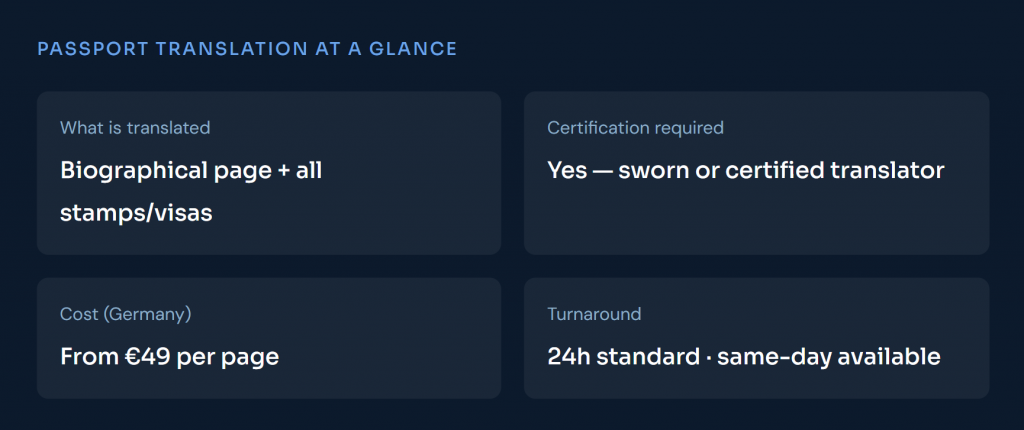
When do you actually need a passport translation?
The short answer: whenever you submit your passport to an official body that operates in a different language, that body requires a certified translation rather than accepting the original document alone.
The most common situations are:
- German immigration applications. The Ausländerbehörde requires certified German translations of foreign-language passports for visa, residence permit, and citizenship applications. This is one of the most common use cases for passport translation in Germany.
- USCIS and US immigration. The United States Citizenship and Immigration Services requires certified English translations of any foreign-language document submitted with an immigration application, including passports.
- University admissions. Many European and international universities require certified translations of identification documents as part of international student admissions.
- Court proceedings. If your passport is used as evidence in legal proceedings in a foreign country, a certified translation is required.
- Employment and background checks. Some employers and background check agencies require certified translations of identity documents.
- Financial and banking applications. Opening bank accounts, applying for mortgages, or processing international transactions may require certified passport translations.
- International marriage registration. Registering a marriage in a foreign country typically requires certified translations of identification documents including passports.
One important nuance: not every authority that “needs to see your passport” requires a formal certified translation. Many institutions accept the original passport for visual verification. A certified translation is specifically required when the authority needs to process or file the document in a language different from the passport’s original language. If you are unsure, contact the receiving authority directly before ordering.
What does a passport translation actually include?
This varies depending on the purpose. Most standard passport translations cover the biographical data page, the main information page with the photo. But a complete translation may need to cover more:
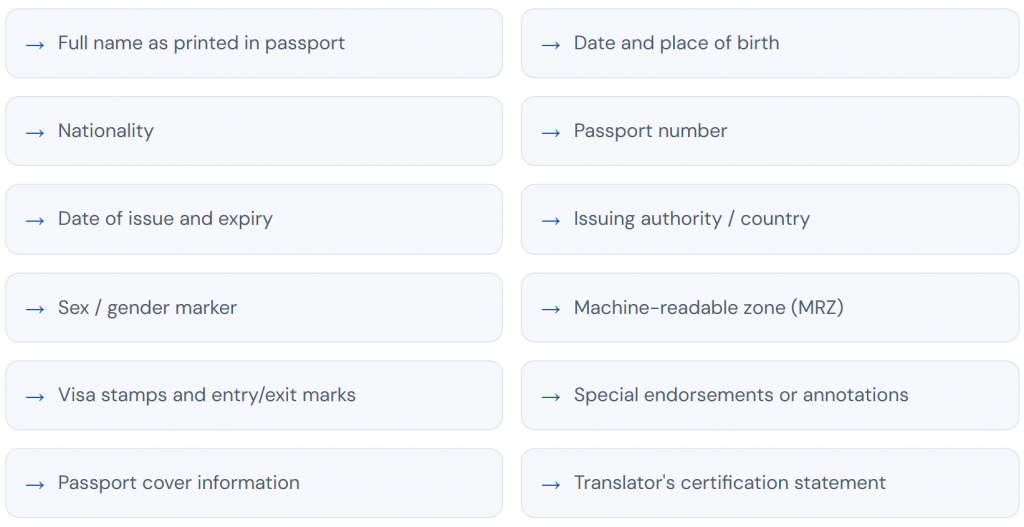
For immigration applications, it is common to need all pages translated, including blank pages (noted as blank), any visa stamps, entry/exit stamps, and endorsements. Authorities use visa history and entry records to assess travel patterns and application consistency.
What “certified” means, and what it doesn’t
The term “certified translation” means different things in different countries, which causes significant confusion. Here is how it works in the two most relevant contexts:
In Germany
A certified passport translation in Germany must be produced by a translator who is publicly appointed and sworn in by a German district court (Landgericht). These are known as beeidigte Übersetzer or vereidigte Übersetzer. The translator certifies the translation by adding a certification statement, their personal court stamp, handwritten signature, and date.
A generic “certified” stamp from an overseas translation agency is not accepted by German authorities. The court registration is what creates legal validity in Germany.
In the United States (USCIS)
USCIS requires that certified translations include a signed Certificate of Accuracy, a statement from the translator (or a company representative) attesting that the translation is accurate and complete, and that the translator is competent in both languages. USCIS does not require court registration, but the translator cannot have been the document owner. Notarization is not required by USCIS but may be requested by other US institutions.
| Country / Authority | Certification requirement | Notarization needed? |
| Germany (Ausländerbehörde, courts) | Court-registered sworn translator (beeidigte Übersetzer) | No — court stamp is equivalent |
| United States (USCIS) | Signed Certificate of Accuracy from translator | No (unless specifically requested) |
| United Kingdom (Home Office) | Professional translator with signed declaration | No |
| Canada (IRCC) | Certified translator or member of recognised translators’ association | No |
| Australia (Immigration) | NAATI-certified translator (preferred) | No |
| Most European universities | Sworn translator of the country where the university is located | Varies |

How much does a passport translation cost?
Passport translation is typically priced per page (usually defined as the translated document page, not the original). The biographical data page of most passports counts as one page of translation.
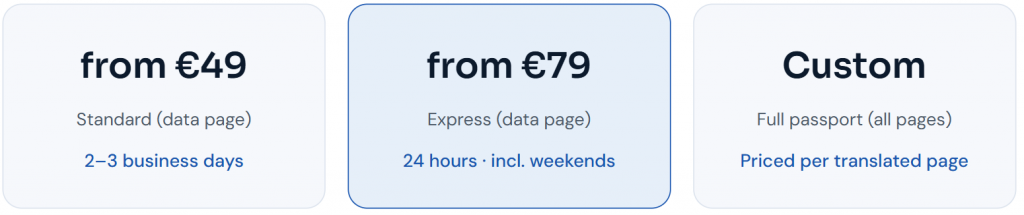
The main factors affecting price are: language pair (less common pairs cost more due to fewer available translators), turnaround time (express commands a premium), and total page count. A standard German passport with a biographical data page and several visa pages might be 3–5 pages of translated content; a well-travelled passport with many stamps can be significantly more.

5 mistakes that get passport translations rejected
These are the most common reasons a certified passport translation fails to be accepted by authorities:
- Using a non-registered translator for German authorities
The single most common error. An overseas “certified” translation is not accepted by German Ausländerbehörde, courts, or notaries. The translator must be registered with a German district court.
- Translating only the data page when all pages are required
Immigration applications often require all pages, including visa stamps, entry/exit marks, and endorsements. Only ordering the data page when the full passport is needed leads to rejection.
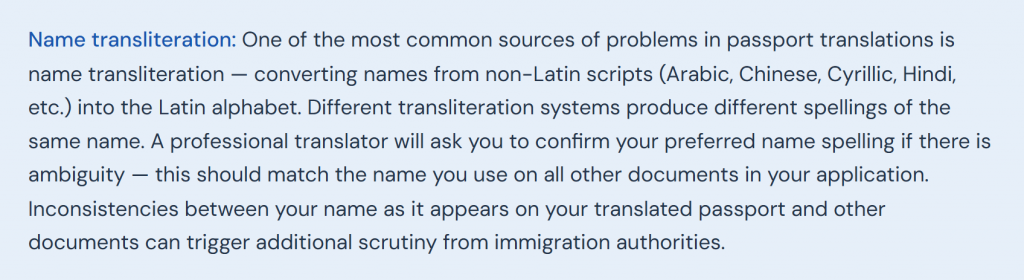
- Name spelling inconsistency
The name in the translated passport must match your name as it appears on other application documents. Different transliterations of the same name across documents signal inconsistency and can cause delays or requests for additional documentation.
- Submitting a copy of the translation without the original certified document
German authorities require the original certified document (with the original handwritten signature and court stamp) not a photocopy. If you need to submit to multiple bodies, order multiple originals or confirm in advance whether certified copies are accepted.
- Using a translation of an expired passport
If your passport has been renewed since your last translation, you need a new translation of the current passport. Submitting a certified translation of an expired document creates an obvious mismatch with your current identification.
How to order a passport translation. Step-by-step
- Confirm what is required. Check with the receiving authority whether they need a sworn translation (Germany) or a signed Certificate of Accuracy (US), and which pages they require.
- Prepare a clear scan or photograph. Every page that needs to be translated must be legible, all text, stamps, and signatures visible, all four corners of each page in frame. Blurry or cut-off scans cause delays.
- Request a quote. Linguidoor will give you a fixed price and a confirmed delivery date before you commit.
- Confirm your name spelling. If your name contains characters that require transliteration, specify how you want your name spelled to ensure consistency with your other documents.
- Receive and check the translation. Before submitting, verify that all data on the translation matches the original exactly, name, dates, passport number, and all other details.
- Keep a copy. Retain a copy of both the original document and the certified translation for your records.
Frequently asked questions
- Do I need to send my original passport to Linguidoor?
No. A clear scan or high-resolution photograph of your passport is sufficient for translation purposes. You do not need to send the physical original. Linguidoor works from the digital copy and produces the certified translation document. Your original passport stays with you throughout the process.
- How do I know if the translation will be accepted?
If your translation is produced by a court-registered sworn translator in Germany (for German authority submissions), it will be accepted. For USCIS submissions, a signed Certificate of Accuracy from a professional translator is required and sufficient. At Linguidoor, we confirm the specific acceptance requirements for your destination authority before producing the translation, and all our sworn translations for German use are produced by court-registered translators.
- Can I get a passport translation on the same day?
Yes. Same-day passport translation (typically for the biographical data page) is available from Linguidoor for urgent cases. For multi-page passport translations including all stamps and visas, same-day delivery depends on the total volume. Contact us with your deadline and we will confirm availability immediately.
- What languages can you translate my passport from?
We cover 40+ languages for certified passport translation. This includes German, English, French, Italian, Arabic, Chinese (Simplified and Traditional), Russian, Turkish, Polish, Ukrainian, Persian (Farsi), Hindi, Urdu, and all major European and Indian languages. For rare language combinations, turnaround may be slightly longer. Contact us and we will confirm availability and timeline.
- Is a certified passport translation the same as a notarized one?
Not always. In Germany, a sworn translation by a court-registered translator carries equivalent legal weight to notarization; the translator’s court stamp and declaration is what creates legal validity, not a notary’s signature. In the United States, USCIS accepts certified translations without notarization. Some courts, financial institutions, or foreign authorities may additionally require notarization (a notary’s stamp confirming the translator’s signature). We can arrange notarization on request.