
You’ve probably heard the term. You might even think you know what it means. But website localization is one of those concepts that’s easy to define superficially and easy to execute badly.
This article gives you the full picture: a clear definition, concrete real-world examples, and an honest answer to why it should matter to your business, regardless of your size or industry.
This article is part of our comprehensive guide to website localization. For the complete framework covering strategy, tools, and implementation, see our Website Localization: The Complete Guide.
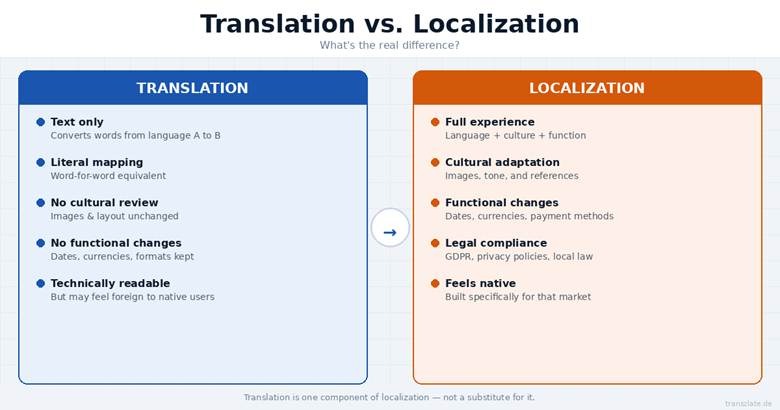
Figure 1: Translation converts language — localization adapts the entire experience.
The Short Definition
Website localization is the process of adapting a website to meet the language, cultural, and functional expectations of users in a specific target market.
It is not just a translation. And that distinction is critical.
Translation converts text from one language to another. Localization goes further, it adapts the entire experience: the images, the layout, the pricing format, the payment methods, the tone, the legal language, and even the color palette if cultural norms demand it.
A localized website doesn’t feel like it was built somewhere else and translated. It feels like it was built for the user reading it, in the place they live, in the way they expect.
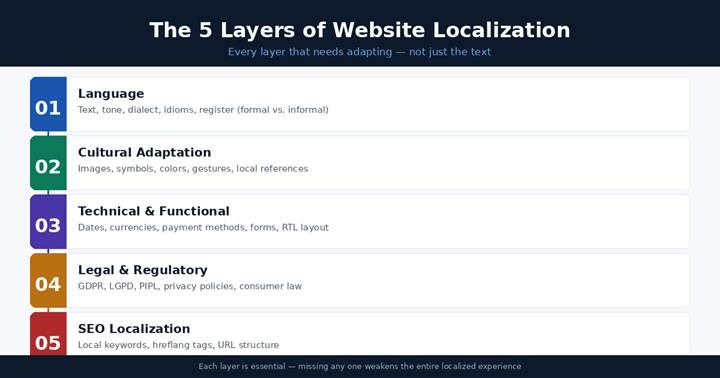
Figure 2: The five layers of website localization — every dimension that requires adaptation.
The Full Definition: Breaking It Down
To understand what website localization really involves, it helps to look at all the layers:
Language
The most visible layer. Every piece of text (body copy, headings, CTAs, navigation labels, error messages, form fields, legal disclaimers) is rendered in the user’s language with accuracy and fluency.
But language localization isn’t just vocabulary. It includes:
● Dialectal differences: Brazilian Portuguese vs. European Portuguese. Latin American Spanish vs. Castilian Spanish. Simplified Chinese vs. Traditional Chinese. These are different localizations, not the same one.
● Tone and register: Some markets expect formal addresses (French vous, German Sie). Others expect warmth and informality (Brazil, Australia). The same brand voice manifests differently in each language.
● Idioms and expressions: Marketing copy is full of idioms. “Hit the ground running,” “low-hanging fruit,” “think outside the box”, these don’t translate. They need to be rewritten in culturally equivalent terms.
Cultural Adaptation
This is where localization separates itself from translation most dramatically.
● Images and photography: A website selling financial services might use imagery of confident professionals. In the US, that might mean a diverse group in a glass office. In Japan, it might mean a single figure in a quiet, orderly setting. Same product message, different visual representation.
● Color symbolism: White represents purity and weddings in Western markets, and mourning in many East Asian cultures. Red signals danger in some contexts and luck and prosperity in others. Localization reviews and adapts visual choices accordingly.
● Gestures and symbols: The thumbs-up gesture is positive in most Western countries and offensive in parts of the Middle East and West Africa. An OK sign carries positive meaning in the US and a rude meaning in Brazil and Turkey.
● Local references: Sports metaphors, celebrity references, seasonal holidays, pop culture callbacks, all require review and replacement with locally relevant alternatives.
Technical and Functional Adaptation
A localized website also works differently in different markets:
● Date and time formats: MM/DD/YYYY (US) vs. DD/MM/YYYY (Europe) vs. YYYY/MM/DD (Japan/ISO). Incorrect formats cause confusion and erode trust.
● Currency and number formatting: $1,000.00 vs. €1.000,00, the comma and period are used differently across locales. Get this wrong and pricing pages look like errors.
● Payment methods: PayPal works globally. But German users expect Sofort or Giropay. Dutch users expect iDEAL. Brazilian users expect PIX or Boleto. A localized checkout flow includes locally preferred payment options.
● Forms: Name fields (some cultures use given name first, others family name first), address formats, phone number formats, these all vary by country.
● RTL support: Arabic, Hebrew, Persian, and Urdu are written right-to-left. A localized website for these markets requires a fundamentally different layout, not just mirrored text, but redesigned navigation, button placement, and content flow.
→ Building for RTL markets? See our full guide: Arabic Website Localization: RTL Design, Cultural Norms, and Technical Challenges
Legal and Regulatory Compliance
This is the layer most people forget, until it becomes a problem.
● GDPR (EU): Consent banners, data processing notices, user rights disclosures. These aren’t just translated, they’re legally mandated to be accurate and compliant under European law.
● LGPD (Brazil): Similar to GDPR, with its own specific requirements.
● PIPL (China): Among the world’s strictest data privacy frameworks.
● Consumer protection law: Refund policies, pricing transparency, warranty language, all carry legal weight that varies by jurisdiction.
SEO Localization
Finally, a localized website needs to be found. That means:
● Local keyword research: Not just translating your English keywords, but researching what users in each market actually search for. “Accounting software” in English doesn’t map directly to the German search behavior, Germans search for Buchhaltungssoftware, but they also use specific regional terms and phrases that differ from translated equivalents.
● Hreflang tags: HTML signals that tell Google which version of your page to serve in which language and region.
● Local URL structure: Subdirectories (/de/), subdomains (de.yoursite.com), or ccTLDs (.de) each carry different SEO implications.
Website Localization vs. Translation: The Key Difference
The simplest way to understand the difference:
Translation changes the language. Localization changes the experience.
A translated website is technically readable in a new language. A localized website is one that users trust, feel comfortable on, and convert from.
Here’s a comparison using a real-world scenario:
Scenario: A US-based SaaS company wants to enter the German market.
→ Entering Germany? Read our dedicated guide: Website Localization for Germany: What Businesses Get Wrong
| Element | Translated Only | Properly Localized |
| Page copy | German text (direct translation) | German text adapted for formal address (Sie) and German business culture |
| Pricing page | $99/month | €89/month with VAT shown (legally required in Germany) |
| Date formats | 01/15/2026 | 15.01.2026 |
| Payment methods | Visa, Mastercard, PayPal | Visa, Mastercard, PayPal + SEPA Direct Debit + Sofort |
| Legal pages | Translated US Terms of Service | Germany-compliant Terms + German privacy policy per DSGVO (German GDPR) |
| Cookie banner | Translated US-style banner | GDPR-compliant banner with proper consent mechanism |
| Blog content | Translated US blog posts | German-language content written for German search queries |
The translated site might be accessible. The localized site actually converts.
→ For a full breakdown of every difference, see: Website Localization vs. Website Translation: A Complete Comparison
Real-World Examples of Website Localization Done Right
Example 1: Airbnb
Airbnb operates in over 220 countries and regions, with localized experiences across 60+ languages. Their localization goes well beyond translation:
● Pricing is displayed in local currency with locally appropriate formatting
● Date pickers reflect local calendar conventions
● Payment methods are tailored by market (Alipay in China, local bank transfer options in various regions)
● Photography features locally relevant homes and local people
● Trust signals (reviews, host verification) are adapted to what matters most in each market
Airbnb treats each market as a distinct product experience, not a copy of the US site in a different language.
Example 2: IKEA
IKEA’s websites across different markets look similar but behave very differently:
● The Saudi Arabia site is RTL-adapted for Arabic
● Prices reflect local tax structures and are formatted to local conventions
● Product names that don’t translate well are handled with care (notably, IKEA has occasionally run into issues with product names having unintended meanings in other languages)
● Delivery options, store finders, and service availability are all market-specific
● Content and imagery are adapted to local home design preferences and cultural norms
Example 3: Netflix
Netflix’s localization operation is one of the most sophisticated in the world:
● Subtitle and dubbing quality adapted to market preferences (Japan prefers subtitles; many European markets prefer dubbing)
● Content recommendations weighted by local viewing behavior
● Marketing and promotional copy adapted to local humor, celebrities, and cultural events
● Payment methods localized by market
● Help centers fully localized, not just translated
Example 4: A Small E-commerce Business
Localization isn’t only for enterprises. A UK-based skincare brand expanding into France can make a significant difference with:
● French-language product descriptions that account for French beauty vocabulary and expectations
● Pricing in euros with French tax included (as required by French consumer law)
● GDPR-compliant cookie consent designed for French regulatory standards
● Imagery featuring models that reflect the French consumer’s aesthetic expectations
● A French-language customer service email address and response team
Even a 10-page website, properly localized, can open a new market.
→ Selling internationally? See our in-depth guide: eCommerce Website Localization: How to Sell Internationally Without Losing Conversions
Why Website Localization Matters
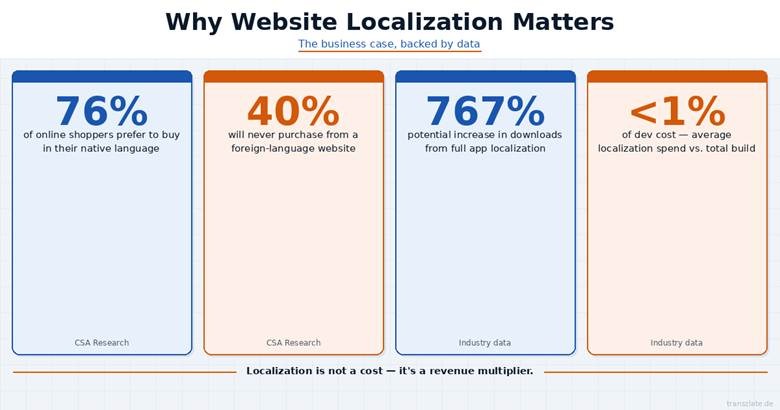
Figure 3: The business case for website localization — key statistics.
Let’s be direct: the business case for website localization is strong and well-documented.
1. Consumers Buy in Their Language
According to CSA Research’s landmark study, 76% of online shoppers prefer to buy products in their native language, and 40% will never purchase from a website in a foreign language. Language isn’t just a communication preference, it’s a trust signal. When your website speaks someone’s language fluently and naturally, it signals that you understand them and you’re committed to serving them.
2. You’re Leaving Revenue on the Table Without It
If you have traffic from non-English-speaking countries landing on an English-only website, you have a leaky funnel. Those users understand your value proposition enough to find you, but they’re bouncing because the experience doesn’t meet them where they are. Localization closes that gap.
3. Local Competitors Are Already Doing It
In most markets, you’re not competing against other international brands on an equal footing. You’re competing against local companies who already communicate in the user’s language, understand the local regulatory environment, and have built local trust over years. Localization is how you compete.
4. SEO Can’t Work in Markets Without Localization
If you want to rank in German Google for German search queries, you need German-language content optimized for German search intent. There’s no workaround. Localization is the prerequisite for international SEO.
5. It Signals Commitment to the Market
Buyers (especially B2B buyers) evaluate vendors partly on perceived commitment. A fully localized website is a signal: we take this market seriously. We built something for you. That signal matters in sales conversations, in procurement decisions, and in word-of-mouth within the local market.
What Website Localization Is Not
Just as useful as knowing what localization is, is knowing what it isn’t:
It’s not a one-time project. Websites change constantly. New pages, new features, new campaigns, all of it needs to flow through your localization process. Localization is a continuous workflow.
It’s not a shortcut for cultural research. Localization adapts your existing content; it doesn’t replace the need to understand whether your product, messaging, and positioning actually resonates in the target market.
It’s not always the same as internationalization. Internationalization (i18n) is the technical preparation that makes your website capable of being localized, building in i18n support for multiple languages, character sets, and layouts. Localization is what happens after.
→ For a developer’s breakdown: Website Internationalization (i18n) vs. Localization (l10n): What Developers Need to Know
It’s not about erasing your brand. Localization adapts your expression; it doesn’t reinvent your identity. Your logo, core product value, and brand personality should remain consistent. Only the expression of that brand changes to fit the local context.
How Localization Fits Into a Bigger Strategy
Website localization is one part of a broader international growth strategy. The most successful international expansions combine localization with:
● Market research: Understanding local customer needs, competitive landscape, and cultural context before investing in localization
● Local SEO: Building discoverability in local search engines with localized content and technical SEO
● Localized paid media: Matching ad creative and landing pages to local expectations
● Local customer support: Offering support in the language and time zone of the target market
● Local partnerships and distribution: Identifying in-market partners who understand local buying behavior
Ready to get started? These guides will help:
→ 7 Steps for a Seamless Website Localization Process
→ Top 10 Website Localization Best Practices and Their Biggest Benefits
Localization is the foundation, but it works best when the whole go-to-market motion is locally adapted.
FAQs
Is website localization worth it for small businesses?
Yes, especially if you’re already receiving organic traffic from international markets. Even basic localization of your highest-traffic pages can meaningfully improve conversion rates. You don’t need to localize everything at once to see results.
→ Wondering about the budget? See: Website Localization Cost: What You Should Expect to Pay
How is website localization different from globalization?
Globalization (g11n) refers to the overall business strategy of entering international markets. Localization (l10n) is the specific execution of adapting your website for a particular market. Globalization is the strategy; localization is the tactic.
What languages should I localize in to first?
Start with your analytics. Which countries send the most traffic? Where do you have customers already but no localized experience? Common first choices for English-language websites are Spanish, French, German, and Simplified Chinese, but the right answer depends entirely on your product and market data.
Do I need a separate website for each language?
No. Most localization is handled within a single website using locale-specific URL structures (like /de/ for German). You do not need to build a separate website per language unless there are strong technical or strategic reasons to do so.
How do I know if my website is localized correctly?
The best test is user testing with native speakers in the target market. Linguistic QA catches translation errors; user testing catches cultural misalignment. Both are necessary for high-quality localization.