
Cross-border e-commerce is one of the biggest opportunities in digital commerce. But international expansion done poorly is one of the fastest ways to burn budget and damage brand equity.
The problem is rarely product-market fit. It is execution. Businesses launch international stores with translated product pages and auto-converted currency, then wonder why conversion rates are a fraction of their domestic performance. The gap between translation and full localization is widest in e-commerce, where every layer of the purchase funnel has market-specific requirements.
This guide covers every layer of e-commerce localization that actually affects conversion: product pages, payment methods, checkout flows, customer reviews, legal compliance, and the market-specific details that experienced operators know matter. For the full strategic overview, see the complete guide to website localization.
Why eCommerce Localization Has Higher Stakes
E-commerce localization has higher stakes than most other website localization projects because the impact is directly and immediately measured in completed transactions.
Every localization gap in an e-commerce flow is a potential drop-off point:
• A user lands on a product page in a foreign language — they leave
• Product page is translated but prices show in the wrong currency — confusion, distrust
• Right language and currency appear but checkout does not accept local payment methods — abandonment
• Checkout works but there is no local return policy — hesitation, no purchase
• Purchase completes but the confirmation email arrives in English — weak customer experience, high support load
| Each of these is a fixable localization failure. But they compound. A store that handles language correctly but fails on payment methods is losing conversions to competitors who have done both. |
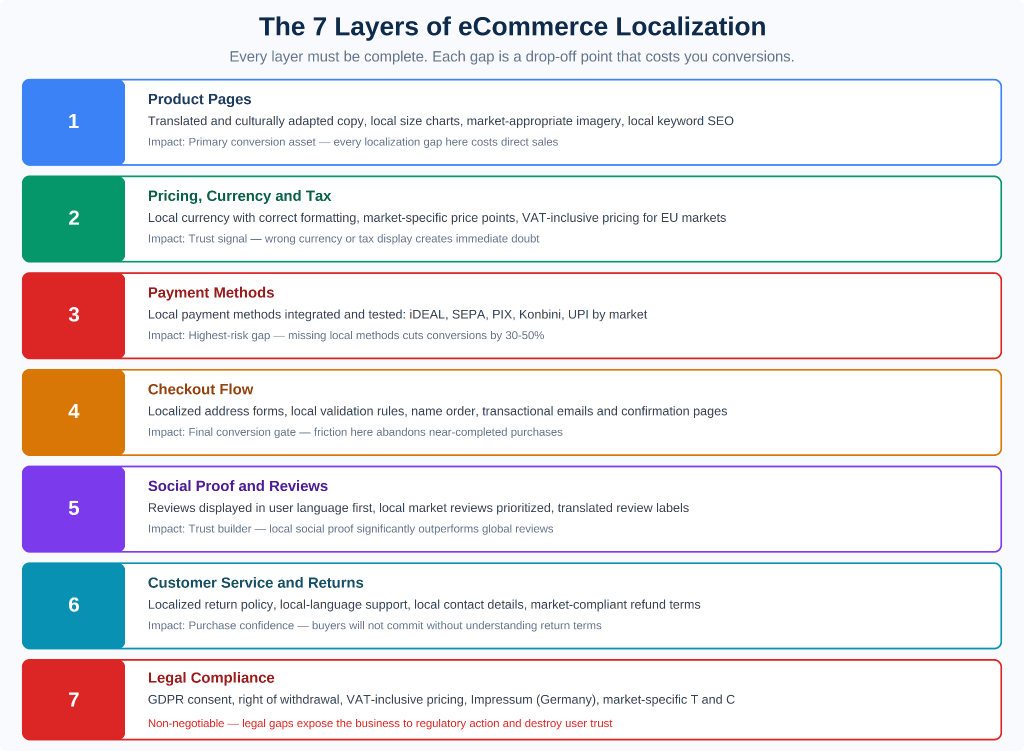
Figure 1: The 7 layers of eCommerce localization. Every layer is a potential drop-off point.
Layer 1: Product Pages
Product pages are your primary conversion asset. They need more than translation, they need full cultural adaptation, local SEO research, and market-appropriate presentation.
Translation and Cultural Adaptation
• Adapt terminology to local conventions. Sneakers in the US may be trainers in the UK or Turnschuhe in Germany, and a user searching locally uses the local term, not the translated English one.
• Match information density to market expectations. Japanese product pages typically include far more detailed specifications, dimensions, materials, and care instructions than Western equivalents. German consumers also expect comprehensive technical information.
• Adapt size charts. Show the local size system rather than linking to a conversion chart. US, European, and UK clothing sizes differ, shoppers should not have to do maths to buy your product.
Product Photography
• Review imagery for cultural appropriateness (body language, backgrounds, and models)
• Consider market-specific photography for major markets that reflects local demographics
• Remove imagery that carries negative cultural associations in specific markets
SEO for Product Pages
Do not translate your English keywords. Research what users in each target market actually search for. The most popular search term for a product in Germany may use a completely different word than a literal English translation. This is one of the most common and most expensive localization mistakes in e-commerce SEO, it looks like organic traffic is low when the real issue is keyword mismatch.
Layer 2: Pricing, Currency, and Tax
Currency and pricing localization goes well beyond showing a different symbol. It requires market-specific price points, correct number formatting, and (critically in the EU) legally compliant tax display.
Currency Display
• Always display prices in the user local currency, detecting location and serving the appropriate currency automatically
• Allow users to switch currency manually for cross-border shoppers who prefer to pay in a specific currency
• Use the correct decimal and thousands separators per locale: 1,234.99 (US), 1.234,99 (Germany), 1 234,99 (France), 1.235 (Japan, no decimals)
Market-Specific Price Points
Automatic currency conversion creates unpredictable, unrounded prices that feel wrong to local shoppers. A product priced at $49.99 converts to EUR 46.83, a number no consumer has ever seen as a natural price point.
Set market-specific prices: rounded numbers that fit local pricing psychology. This also lets you account for different tax structures, import duties, and competitive pricing levels in each market. The full cost implications of maintaining market-specific pricing are worth modelling before you commit to a multi-market rollout.
Tax Display
| Critical in the EU: EU consumer law requires that prices shown to consumers include VAT. Showing a price excluding tax and adding it at checkout is illegal for B2C transactions in the EU. Your product page prices must include VAT in all EU markets. UK rules are identical. US practice (tax added at checkout) is the exception, not the standard. |
Layer 3: Payment Methods
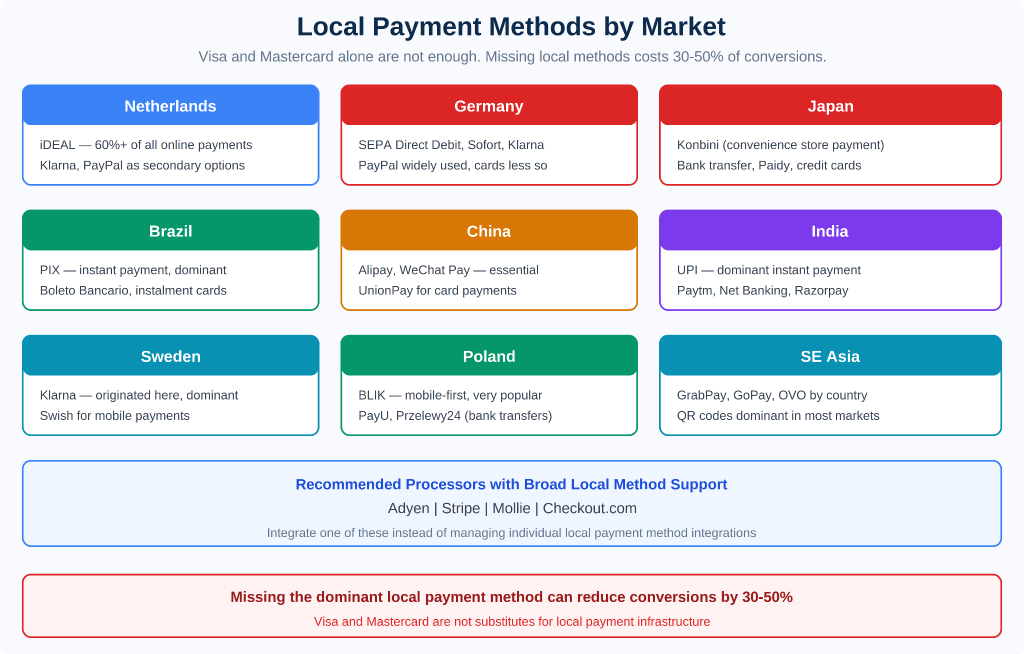
Figure 2: Key local payment methods by market. Visa and Mastercard are not sufficient alone in most of these markets.
Payment method localization is one of the highest-impact, most frequently neglected areas of e-commerce localization. Offering the wrong payment methods can cut conversions by 30 to 50 percent in markets with strong local payment preferences.
This is not a niche concern. In the Netherlands, iDEAL accounts for over 60 percent of online payments. In Brazil, PIX has become the dominant instant payment rail. In Japan, a significant proportion of online shoppers pay via Konbini, collecting and paying for their order at a convenience store. None of these markets consider Visa and Mastercard adequate substitutes for their preferred local method.
| Market | Key Local Payment Methods |
| Netherlands | iDEAL (dominant — 60%+ of online payments), Klarna |
| Germany | SEPA Direct Debit, Sofort, Klarna, PayPal |
| UK | Open Banking, Klarna, PayPal |
| Brazil | PIX (dominant instant payment), Boleto Bancario |
| China | Alipay, WeChat Pay (essential for Chinese customers) |
| India | UPI, Paytm, Net Banking |
| Japan | Konbini (convenience store), bank transfer, Paidy |
| Sweden | Klarna (originated here), Swish |
| Poland | BLIK, PayU, Przelewy24 |
| SE Asia | GrabPay, GoPay, OVO — varies by country |
Implementation: use a payment processor with broad local payment method support (Adyen, Stripe, Mollie, or Checkout.com) rather than integrating each method independently.Platform-specific setup differs on Shopify vs WordPress, so check the relevant implementation guide for your stack.
Layer 4: Checkout Localization
The checkout is where conversions are won or lost. Every friction point at this stage is a lost customer who was already committed to buying.
Address and Form Localization
• Name order: In Japan, Korea, China, and Hungary, family name comes before the given name. Name fields must accommodate both orders.
• Address format: Address structures vary significantly. UK postcodes, German postal codes, and Japanese postal codes have different formats, positions, and validation rules.
• Phone number format: Use a library like libphonenumber for validation across locales, do not apply a single regex pattern globally.
• Tax ID fields: B2B buyers in the EU expect to enter a VAT number at checkout. German businesses specifically expect a field for their Umsatzsteuer-ID.
Post-Purchase Confirmation
Order confirmation pages and transactional emails are almost always the last thing localized, and among the most damaging gaps when missed. A localized purchase experience that ends with an English confirmation email erodes the trust built throughout the funnel. Localize the confirmation page, all transactional emails, and the receipt format including any legally required content per market.
For the full technical QA process that covers form validation, email rendering, and checkout flow testing, see the localization testing guide.
Layer 5: Customer Reviews and Social Proof
Social proof is critical in e-commerce. A review from a customer in the same market carries significantly more weight than a review from abroad.
• Display reviews in the user language first, filter by language, or translate reviews with a clear label
• Prioritize reviews from customers in the same market, a French customer review on a French product page outperforms an American review
• Translate star rating labels and review prompts
• Consider separate review collection per market for major product lines
Layer 6: Customer Service and Returns
Buyers who cannot get support in their language, or who cannot clearly understand your return policy, are less likely to complete a purchase.
• Publish a localized return and refund policy that complies with local consumer law, not a translated version of your English policy
• Provide customer service in the local language at minimum via a localized help centre and chatbot; ideally, human support in local business hours
• Display local contact information, a local phone number or address builds significant trust, particularly in Germany where consumer protection expectations are high
For market-specific customer service and legal expectations, the Germany localization guide and Japan localization guide cover the most demanding cases in detail.
Layer 7: Legal Compliance
E-commerce legal requirements vary dramatically by market. These are not optional additions, they are prerequisites for operating legally in each jurisdiction.
EU and EEA
• GDPR-compliant cookie consent on every page
• Clear right of withdrawal, 14-day return right under EU consumer law
• Total price including VAT displayed before checkout
• Standard Terms and Conditions compliant with local consumer law
Germany
Germany is the most legally stringent e-commerce market in the EU. It requires a legally compliant Impressum, correct distance selling notices, and Terms and Conditions reviewed by a German legal professional. The full breakdown of German market localization requirements covers what businesses consistently get wrong, and the legal exposure that follows.
Japan
Japan requires Personal Information Protection Act compliance and specific requirements around data collection notices. The Japan localization guide covers the disclosure requirements, trust signals, and UX expectations that make Japan one of the most technically demanding e-commerce markets.
eCommerce Localization Checklist
Use this before launch in any new market:
| ☐ | Product titles and descriptions translated and culturally adapted |
| ☐ | Product SEO fields optimized for local search, not translated English keywords |
| ☐ | Size charts show local sizing system |
| ☐ | Product images reviewed for cultural appropriateness |
| ☐ | Prices shown in local currency with correct formatting |
| ☐ | Market-specific price points set, not just currency conversion |
| ☐ | VAT included in displayed prices for all EU markets |
| ☐ | Local payment methods integrated and tested end-to-end |
| ☐ | Address form validates local address formats |
| ☐ | Phone number field accepts local format |
| ☐ | All form validation rules adapted per locale |
| ☐ | Order confirmation page fully localized |
| ☐ | All transactional emails localized |
| ☐ | Return policy is market-compliant, not translated English policy |
| ☐ | Customer service available in local language |
| ☐ | Cookie consent banner is legally compliant |
| ☐ | Legal pages (Privacy Policy, T&C, Impressum) are market-specific |
Frequently Asked Questions
Should I start with one country or multiple at once?
Start with one market, launch, measure, and iterate. Launching in five countries simultaneously multiplies your localization surface area, testing complexity, and risk. Proving a repeatable process in one market first also gives you credible ROI data to justify the next phase of expansion.
How important is a local domain (ccTLD) for e-commerce?
For markets where brand trust is particularly important (Germany, Japan, France) a local domain (.de, .co.jp, .fr) sends a meaningful trust signal. For earlier-stage expansion, subdirectories (/de/, /fr/) are a reasonable starting point with lower technical overhead. Platform-specific URL structure decisions for Shopify differ from WordPress, so check the right guide for your stack.
Should I translate user-generated content like reviews?
For high-traffic product pages, yes, displaying machine-translated reviews clearly labelled in the user language can improve conversion. For lower-traffic pages, the cost-benefit may not justify it. The automated translation guide covers where machine translation is reliable and where it needs human review.
How do I measure whether my e-commerce localization is working?
Track conversion rate by market, revenue per session, and cart abandonment rate by locale as your primary signals. Set baselines before launch. The localization ROI framework gives you the full attribution model and KPI structure for e-commerce specifically.
Which platform is better for international e-commerce, Shopify or WooCommerce?
Shopify Markets has matured significantly and handles currency, markets, and basic translation from a single store. WooCommerce offers more flexibility but requires more technical assembly. Both have real limitations.