
SaaS companies face a localization challenge that is meaningfully different from e-commerce or publishing. You are not just localizing a website. You are localizing a product ecosystem: the marketing site that generates leads, the onboarding flow that activates users, the UI they interact with every day, the help center they rely on, and the pricing page that converts them from trial to paid.
Each layer has different content types, different quality requirements, different update frequencies, and different impact on revenue. Getting the sequencing wrong (starting with blog content when the app UI is still English-only, for example) is one of the most common SaaS localization mistakes.
This guide is for product, growth, and marketing leaders planning international expansion. It covers what to localize, in what order, at what quality level, and how to build a process that scales with your content velocity. For the broader strategic context, the complete guide to website localization covers the end-to-end localization process.
SaaS Localization Is Not Just Website Translation
For e-commerce, the localization surface area is product pages and checkout. For SaaS, it is substantially larger, and each layer has fundamentally different quality and process requirements. The difference between translation and full localization is most pronounced in SaaS, where the app UI, onboarding, and help center all carry their own localization requirements.
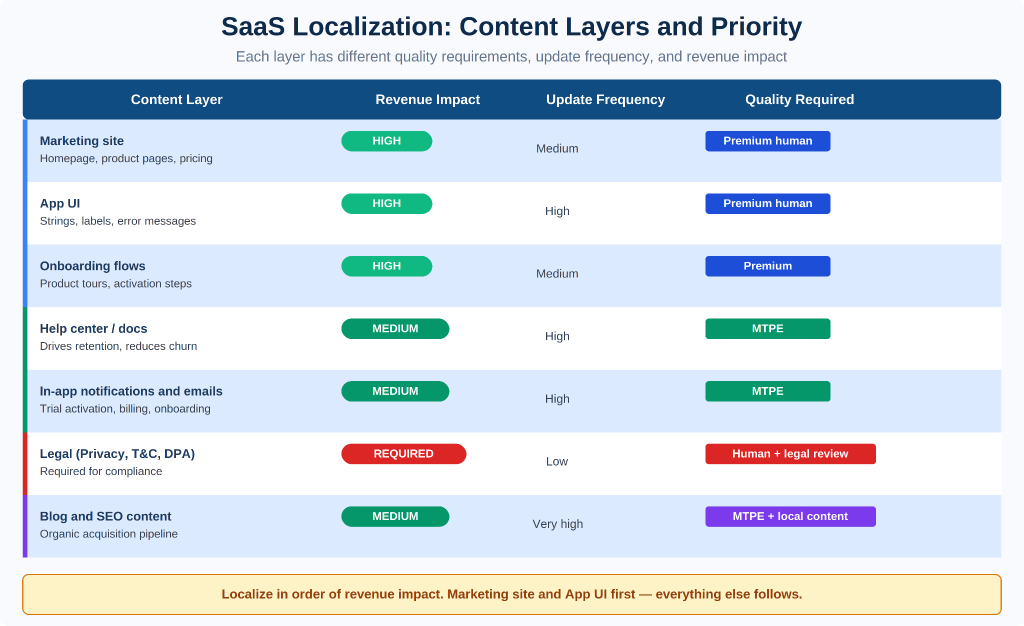
Figure 1: SaaS localization layers ranked by revenue impact and quality requirement. Localize in this order.
Phase 1: Marketing Site Localization
Your marketing site is the first impression for international prospects. It determines whether they convert to a trial, and whether that trial starts from a position of understanding and trust.
Homepage
Localize more than the words. The homepage must reflect how the problem your product solves is framed in the target market. Pain points that resonate in the US may not be how German or Japanese customers articulate the same need, and a literal translation of an American marketing copy often lands poorly.
• Headline and value proposition: may need transcreation rather than translation, the emotional intent must be preserved, not the words
• Social proof: logos, testimonials, and case studies should feature locally recognizable brands wherever possible
• Product screenshots: show the UI in the local language, an English UI screenshot on a German page undercuts trust
• CTAs: test alternatives to direct translations; the emotional weight of phrases like Start Free Trial varies significantly across cultures
Pricing Page
Pricing page localization is among the highest-impact, most neglected areas of SaaS marketing site work.
• Show pricing in local currency with correct formatting, not USD with a note saying prices are in dollars
• Show VAT inclusively in EU markets, which is required by law for B2C and expected by B2B buyers
• Adapt plan names that do not translate naturally
• Include localized billing FAQs covering payment methods, invoicing, and VAT receipts
| Common mistake: Showing USD prices to European users with a note saying all prices are in USD. European B2B buyers expect EUR, VAT-inclusive pricing as standard. This single gap creates an immediate conversion barrier that no other localization effort can compensate for. |
Case Studies and Social Proof
Featuring only US or UK customers on every market homepage is a missed opportunity that experienced international buyers notice immediately.
• Translate existing case studies for each target market
• Develop at least one market-specific case study per major target market
• Feature logos of locally recognizable brands in homepage social proof sections
Phase 2: Application UI Localization
App UI localization has the lowest tolerance for errors of any content layer. A mistranslated UI element affects every user every day they use your product. The technical groundwork for UI localization (string externalization, i18n library setup, locale routing) must be in place before any translation work begins.
String Extraction and Management
The first step is externalizing all translatable strings from your codebase. No user-facing string should be hardcoded in a component. Use an i18n library appropriate for your stack:
• React: react-i18next, most widely adopted, excellent ecosystem
• Vue: vue-i18n, official Vue internationalization library
• Angular: @angular/localize, official Angular module
• iOS/Android: native platform i18n frameworks
Connect your TMS (Awtomated, Phrase, or Crowdin) directly to your code repository. When developers add new strings, they flow automatically to the translation queue. When translations are approved, they push back and are available in the next build. This is the foundation of the continuous localization workflow that scales with your release cadence.
UI-Specific Localization Challenges
• Text expansion: German, Finnish, and Portuguese strings run 30-40% longer than English. Every UI component must use flexible layouts. Fixed-width buttons, truncated labels, and rigid table headers break when languages expand.
• Text contraction: Chinese and Japanese strings are often significantly shorter than English, creating awkward whitespace in fixed-height UI elements.
• Terminology consistency: SaaS products have specialized vocabulary, feature names, UI element names, status labels. Build a glossary per target language and enforce it across all translators. Inconsistent terminology destroys usability.
• Placeholder and variable handling: strings containing variables must be translated with the variable in the grammatically correct position. German verb position differs from English. Ensure your i18n framework supports correct variable substitution.
Phase 3: Help Center and Documentation
Your help center is a significant driver of user activation, retention, and support cost reduction. Localized help center content typically reduces support ticket volume from that language group by 20-40%, a meaningful efficiency gain that compounds as your international user base grows.
• Prioritize: start with your 20-30 highest-traffic articles. These cover the most common user questions and have the highest activation impact.
• Quality level: machine translation with human post-editing (MTPE) is appropriate for most help center content. The bar is accuracy and clarity, not brand voice.
• Maintenance: integrate your help center CMS with your TMS so that when an article is updated, translations are automatically flagged for review. Stale help content is a support cost that compounds invisibly.
Phase 4: Onboarding and In-App Messaging
Users in their first 7-14 days carry the highest churn risk. An onboarding flow that is partially or poorly translated breaks the activation experience at the most critical moment in the user lifecycle.
• Tools: if you use Intercom, Appcues, Pendo, or Chameleon for in-app messaging, check localization support for your specific toolchain before designing the workflow
• Quality: premium human translation or MTPE with careful human review. These strings are short, brand-sensitive, and high-stakes. Machine-only translation is not appropriate for this layer.
• Coverage: welcome flows, feature tooltips, usage nudges, empty states, and all in-app educational content should be treated as a single localization unit
Phase 5: Transactional and Marketing Emails
Transactional emails are often the last thing localized, and one of the most damaging gaps when missed. A localized product experience that ends with an English billing email erodes the trust built throughout the funnel.
Localize: welcome emails, trial activation and onboarding sequences, billing notifications, and feature announcements.
Do not localize: internal operational emails, or emails that existing international users have already opted into in English.
VAT receipts deserve special attention. B2B customers in the EU who need VAT receipts for tax purposes expect them in the correct format for their country. Work with your billing team to generate market-compliant VAT invoices, this sits at the intersection of localization, finance, and legal compliance.
SaaS-Specific International SEO
SaaS SEO in international markets requires a different approach from e-commerce. B2B software buyers search differently from consumers, and search behavior in your target markets may be substantially different from English-language patterns.
Software-Specific Search Intent
• Problem-aware queries: how problems are articulated in the local language, German search behavior may frame a workflow challenge differently from US buyers
• Solution-aware queries: your product category in the local language, which may not be a direct translation
• Competitor comparisons: local SaaS competitors may be prominent in target markets and absent from English-language competitive research
• Integration queries: what tools your product integrates with may carry different search volume in each market
Local Competitor Research
In many markets, local SaaS competitors have significant advantages in brand recognition and established customer bases. Research who you are competing against in each market, it may not be the same companies you compete with in English-speaking markets. This has direct implications for your positioning, messaging, and content strategy.
Content Strategy for New Markets
A fully localized marketing site gets you into the market. A market-specific content strategy builds a sustainable organic acquisition pipeline.
• A localized blog covering topics relevant to local use cases and pain points
• Local language thought leadership that positions your brand in the market
• Integration of local industry references, regulations, and market context
The cost of executing this content strategy scales with your target language count and content velocity. The full cost breakdown is worth modelling before you commit to a multi-market content rollout.
Building a Scalable SaaS Localization Process
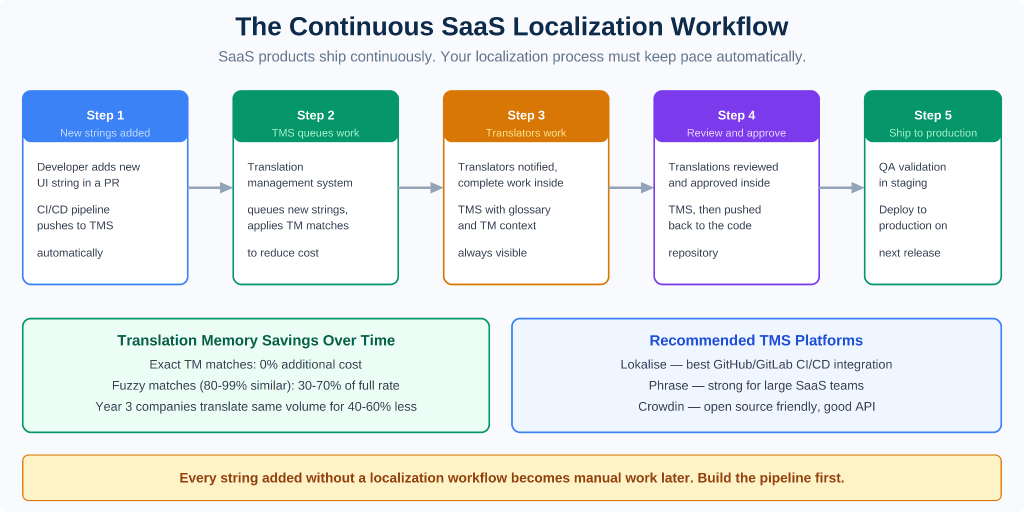
Figure 2: The continuous localization workflow. New strings flow to TMS automatically, translations flow back, and TM savings compound over time.
SaaS products ship continuously. Your localization process must keep pace, which means integrating with your development and content pipelines rather than running alongside them as a separate manual process.
The Continuous Localization Model
1. New UI strings added in a PR, CI/CD pipeline pushes new strings to TMS automatically
2. TMS queues new strings for the translation workflow, applying translation memory matches to reduce cost
3. Translators receive notifications and complete work inside TMS with glossary and TM context always visible
4. Approved translations pushed back to the repository automatically
5. QA validation in staging before production deployment
6. Monitoring flags any missing translations in production
Translation Memory Investment
Translation memory stores every previously translated string. As your product matures and your TM grows, translation costs decrease significantly. Exact matches cost nothing additional. Fuzzy matches (80-99% similar) cost 30-70% of the full rate. A SaaS company with three years of TM accumulation can translate the same volume for 40-60% less than in year one.
This is why the ROI of localization investment compounds more strongly in SaaS than in most other categories. Early investment in proper i18n infrastructure and TM accumulation pays dividends for years. For the tooling that makes this work, the 2026 localization tools guide covers the leading TMS platforms in detail.
Quality Assurance for SaaS Localization
SaaS localization QA has two distinct layers: linguistic quality (is the translation accurate and appropriately toned?) and functional quality (does the localized UI render correctly, do form validations work, do email templates format properly in all clients?)
For the full QA process covering both layers (including the pre-launch checklist, testing tools, and how to structure review rounds) see the localization testing guide. For UI-specific testing,the i18n vs l10n guide covers pseudolocalization and string extraction verification in detail.
Frequently Asked Questions
Should I localize the product or the marketing site first?
This depends on your go-to-market model. If you are product-led (trials, freemium) localize the product experience first. International users who sign up for a trial and hit an English UI churn immediately, and no amount of marketing site localization recovers that. If you are sales-led (demos, enterprise) localize the marketing site first, since that is what generates the leads your sales team converts.
How many languages should a SaaS company start with?
Most SaaS companies start with 1-3 languages for their first international push. German, French, Spanish, and Japanese are commonly prioritized based on market size and willingness-to-pay metrics. The right answer depends on where your existing user base, inbound traffic, and product-market fit signals are strongest.
Can we use AI for SaaS UI translation?
AI translation has improved substantially and is now appropriate for many SaaS content types with human review. For UI strings *especially marketing copy, error messages, and onboarding flows) always use human post-editing. The automated translation guide covers where machine-first approaches are reliable and where they consistently produce quality issues.
How do I choose the right localization partner for SaaS?
SaaS localization requires a partner comfortable with technical content, high update frequency, and TMS integration. A partner who handles only document translation will struggle with the continuous localization cadence of a shipping SaaS product. The guide to choosing a localization service covers the criteria specific to software companies.
Related Articles
This article is part of the website localization content cluster.
🛒 eCommerce Website Localization: How to Sell Internationally — Conversion-focused localization for transactional products